Pierres Vives

Architectural Concept

Our design is based on a series of key qualities that characterise the new building for the Department of Herault:
 Zaha Hadid Architects
The building should be a new landmark on the edge of Montpellier, a visible icon of progressive regional government.
- Zaha Hadid Architects
This large complex of institutions requires an efficient and clear organisation, both for the benefit of easy public access/orientation and for the sake of a productive and pleasant working atmosphere.


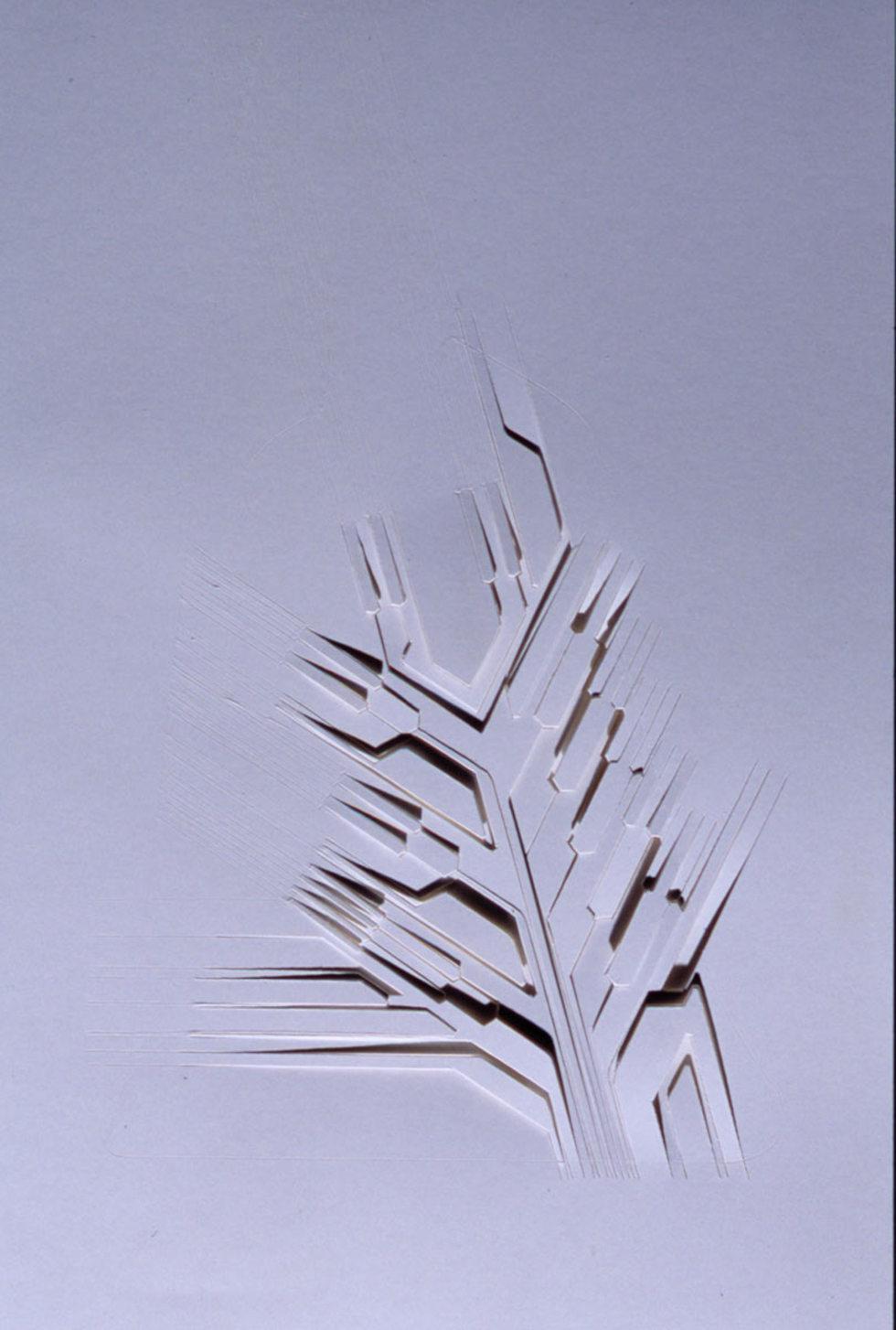
The three institutions - the archive, the library and the sports department - are unified within a single, envelope. The three parts of this "cite administrative" combine into a strong figure visible far into the landscape. As one moves closer, the division into three parts becomes apparent.The building has been developed on the basis of a rigorous pursuit of functional and economic logic combined with the organisational diagram of a tree of knowledge. The resultant figure is reminiscent of a large tree-trunk with the archives located at the solid base of the trunk, followed by the slightly more porous library with the sports department and its well-lit offices on top where the trunk bifurcates and becomes much lighter. The branches projecting off the main trunk articulate the points of access and the entrances into the various institutions. All the public entrances are located on the western side of the building; whilst the service entrances for staff and loading bays are on the eastern side. In this way, the tree-trunk analogy is exploited to organise and articulate the complexity of the overall "cite administrative".

Spatial Organisation

The main vehicular access road for visitors as well as for staff and service vehicles is from Rue Marius Petipa, and provides access to either side of the building. There is a generous visitor car park in front of the main entrance lobby. The service access is stretched along the opposite side of the building. This longitudinal division of serviced and servicing spaces is maintained within the ground floor along the full length of the building. The front side contains all the public functions of each institution, linked by a linear lobby and central exhibition space. To the rear of the building, all the service, storage and garage areas are located. Above the ground level, the three institutions remain strictly separated. Each institution has its own internal vertical circulation and is laid out following its specific functional logic.

Upon arrival at the main entrance, visitors are directed from the lobby to the educational spaces of the archives on ground level; or via lifts and escalators to the main public artery on level 1. This artery runs the entire length of the building and is articulated all along the facades as a recessed glass strip. Here, reading rooms of both the archives and library are immediately accessible. Central to this artery and therefore located at the heart of the building, are the main public facilities shared between the three institutions: the auditorium and meeting rooms. These shared public facilities also create the central volume that cantilevers from the trunk, providing a grand canopy for arriving visitors.

CLIENT REPRESENTATIVE: Hérault Aménagement Gilles Papazoglou, Jean-Roch Mirabel Jean-Claude Deperrois

PROJECT ARCHITECT: Stephane Hof

COMPETITION TEAM: Thomas Vietzke, Achim Gergen, Martin Henn, Christina Beaumont, Yael Brosilovski, Lorenzo Grifantini, Carlos Fernando Perez, Helmut Kinzler, Viggo Haremst, Christian Ludwig, Selim Mimita, Flavio La Gioia, Nina Safainia

CONSULTANTS:

Structure Paul Nuttall

Ove Arup & Partners Sophie Le Bourva, Mits Kanada, David Rutter

Services

Ove Arup & Partners Emmanuelle Danisi, Michael Stych

(Concept Design)

GEC Ingenierie Francis Petit, Philippe Vivier
Rene Andrian, Gregory Makarawiez

Infrastructure

GEC Ingenierie Jean Paul Sulima

Acoustics

Rouch Acoustique Nicolas Albaric
Cost
Gec LR Ivica Knenovic
CONCEPTION PHASE TEAM:
Local architect
Blue Tango Architectures Philippe Capelier
Landscape architect
West 8 Maarten Van de Voorde
PRESENTATION TEAM:
Rendering: Stack Studio
Presentation Model: A models